Use cases
The point of a hardware description language is hardware. These are boards whose schematics are CoHDL source — written, checked, compiled, fabricated, and shipped as working devices.
Case study
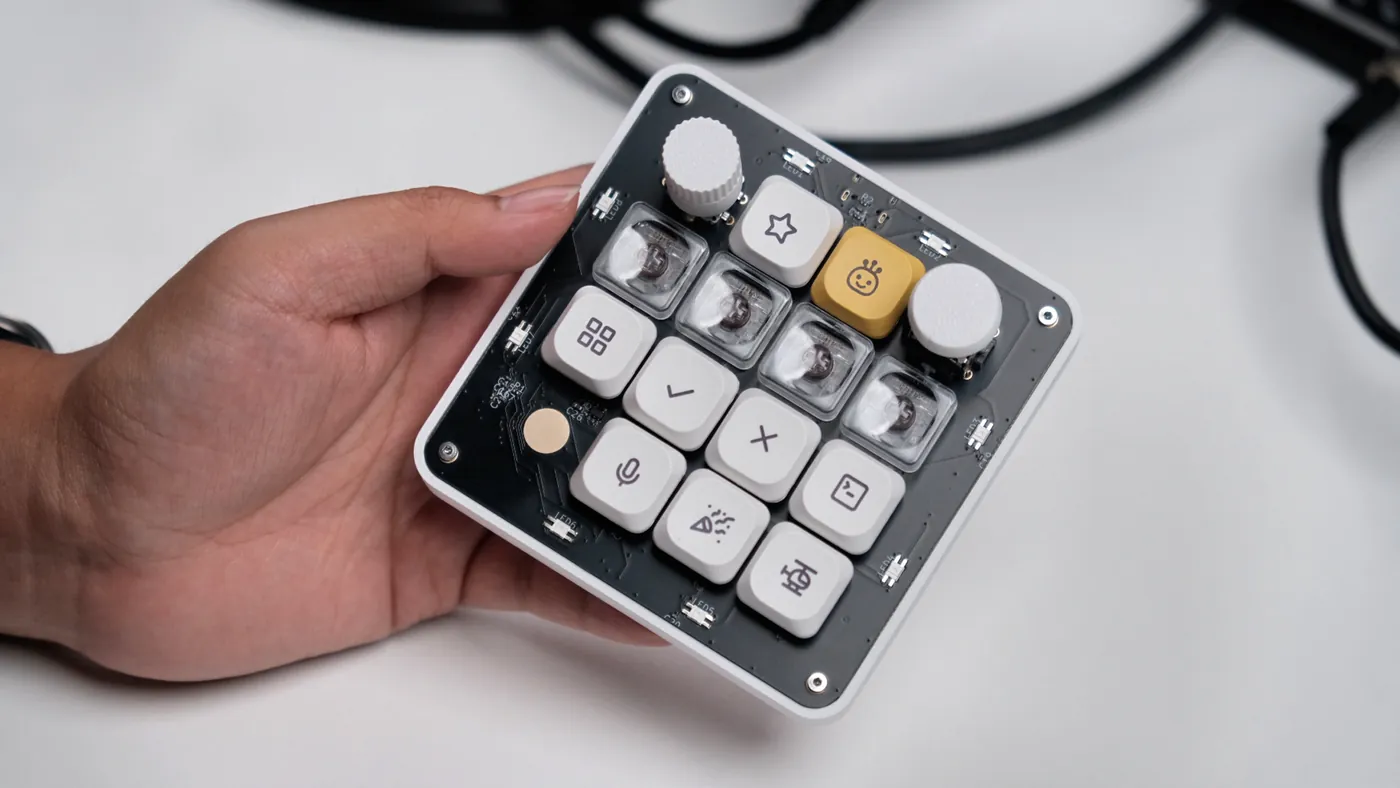
OpenMicroKbd
An open-source, MIT-licensed macropad: 13 keys, a rotary encoder, an analog joystick, a capacitive touch pad and 21 addressable LEDs on an STM32F072. Its entire schematic is 823 lines of CoHDL. The compiler emitted the netlist, BOM and footprints; an autorouter placed and routed the board from the compiler's constraints; the fab built it for about $37.
Reference designs
Two smaller boards ship with the compiler as reference designs and conformance fixtures: a Raspberry Pi Pico 2 carrier and an SF32 miniboard, a SiFli BLE evaluation board. Both exist to exercise the pipeline end to end, and their emitted netlists are regression-tested down to the byte. Browse them under examples/ in the compiler repository.
Built something?
The compiler is a one-line install, and this page is where real boards get collected. If you design something in CoHDL and want it featured here, share it with us on Discord.